
Short answer
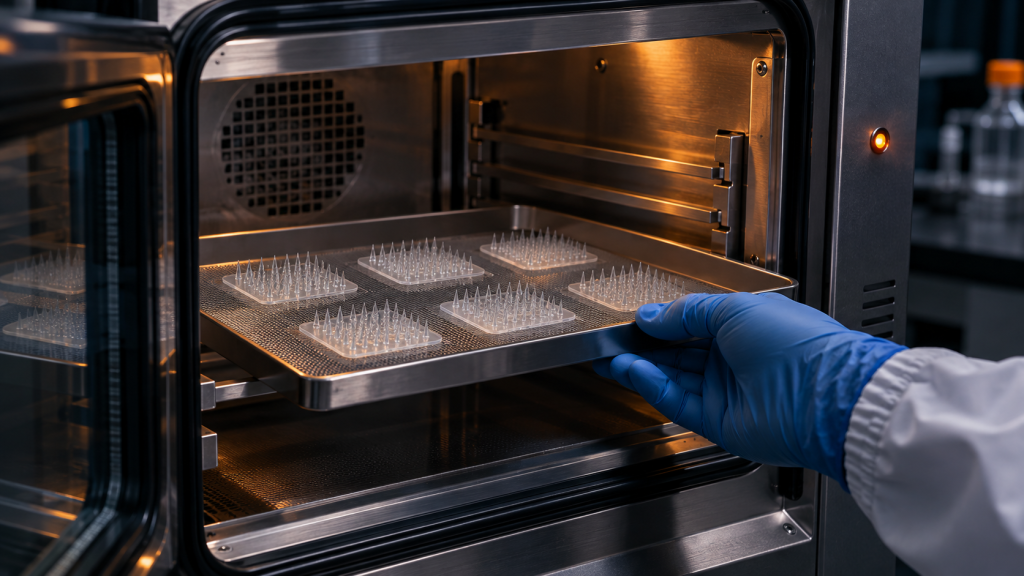
A drying recipe for a dissolvable microneedle patch needs a measurable endpoint. Oven time alone cannot show that the needle tips, backing and packaged patch have reached a consistent moisture state. During development, track water content alongside dry-array dimensions, visible defects and mechanical response. Set the final limits from the proposed formula and its verification data, particularly when a peptide or another moisture-sensitive ingredient is present.
Why drying belongs in the process specification
Water leaves a molded array through a changing geometry. The exposed backing can dry differently from the narrow tips inside a mold. Air temperature, relative humidity, airflow, mold material and fill volume all affect that path. A scalable fabrication study measured patch shrinkage as a function of drying humidity and airflow. Its design and material are study-specific, but the process lesson is practical: the same nominal mold does not guarantee the same dry footprint when the drying environment changes.
A 2024 mechanical-characterization study found mean finished dimensions roughly 5% below the design dimensions in its PVA-based arrays and measured water content by Karl Fischer titration. That percentage is not a correction factor for another product. It is a reason to measure the finished array instead of treating the master drawing as its final geometry.
Define the endpoint before comparing dryer settings
Water content and moisture distribution
Use a method appropriate to the matrix. Karl Fischer measures water chemically; a loss-on-drying method measures total mass lost under its selected conditions and may include other volatiles. Record sample mass, sampling position and time between removal from the dryer and measurement. A patch exposed to room air while waiting for analysis may no longer represent its condition at dryer exit.
Geometry and handling response
Document needle height, tip form, array pitch, backing flatness and demolding yield at the same process points. A patch that meets a moisture target can still have bent tips or a curled backing. Likewise, a visually sharp array may retain enough water to change its mechanical response during storage. The Pharmaceutical Research review of dissolving microneedles discusses water-content methods and the possible effects of water on strength and dissolution. It concerns pharmaceutical research; cosmetic acceptance limits still need product-specific evidence.
Ingredient integrity
If the formula contains a peptide, the development plan should compare its identity and assay before and after the chosen drying cycle. This does not imply that all peptides degrade during drying. A vaccine microneedle study found formulation-dependent changes during drying, illustrating why sensitive biologics require their own analytical checks. Vaccine results cannot be used as cosmetic-peptide performance data.
A compact drying study for a pilot run
- Fix the polymer grade, solids concentration, active loading, mold geometry and dispense volume before comparing cycles.
- Record actual product-zone temperature and relative humidity alongside the dryer’s setpoints. Note airflow, tray position and batch loading.
- Sample early, middle and late positions in the run. Measure water content promptly, then inspect needles and backing with a calibrated method.
- Check a relevant mechanical or insertion-model response and the active assay when the formula calls for it.
- Package representative samples promptly, then challenge them under the project’s stability conditions to see whether the dryer endpoint remains meaningful.
A 2026 PVA microneedle study investigated drying temperature and time among several manufacturing variables and used 40 °C for 24 hours in its selected research procedure. Those settings are a reported experiment, not a default HYTANBIO process or a recommendation for a cosmetic peptide patch.
What to transfer to commercial production
The process record should identify the selected dryer, loading pattern, setpoint ranges, monitored conditions, sampling locations, endpoint method, hold time before sealing and actions for an out-of-range result. A change in mold, backing, fill mass or batch load may alter evaporation even if the thermostat setting stays the same. Recheck the endpoint after such a change before calling the cycles equivalent.
FAQ
Is a fixed oven time enough to release a patch?
No. Time is a process setting. Release requires the agreed finished-product checks, which may include water content, geometry and other attributes justified for that formula.
Can a dry patch absorb water before sealing?
It can if the matrix is hygroscopic and the room or hold time permits moisture uptake. Measure the effect under the actual handling conditions and define the maximum delay to packaging.
Does a lower moisture result always mean a better patch?
No. Drying can also change geometry, handling and ingredient integrity. Select a range using the finished patch’s combined evidence, not a single lowest reading.
Related HYTANBIO resources
References
- A scalable fabrication process of polymer microneedles, 2012.
- Mechanical characterization of dissolving microneedles, 2024.
- Dissolving microneedle patch characterization review, 2017.
- Drying and stability in an influenza-vaccine microneedle research system, 2017.
- Technical challenges and quality considerations for dissolving microneedles, 2026.
Scope: process-development guidance for cosmetic skincare projects. Cited drug and vaccine studies illustrate measurement questions, not approved cosmetic specifications, clinical outcomes or HYTANBIO manufacturing data.