
Short answer
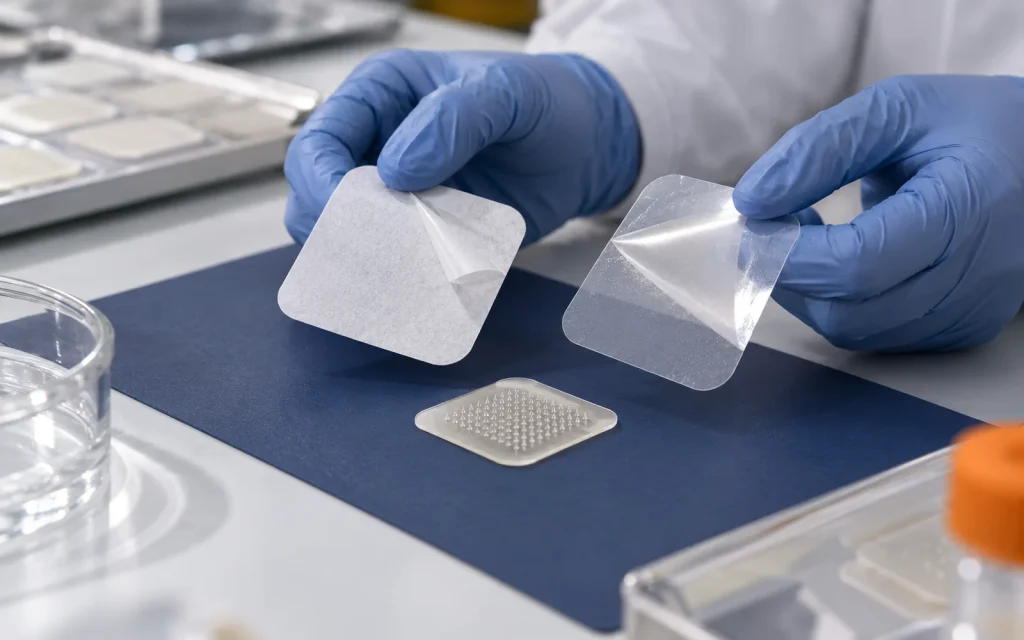
A microneedle patch backing is part of the product design. It determines how the array is handled, placed and protected. The adhesive, release liner and backing film should be screened together with the dissolving matrix; a patch that looks sound on a tray may lift at an edge or damage its array when removed from the liner.
Separate four layers in the specification
Buyers often specify the active and needle geometry while leaving “backing film” to the supplier. That omission can change the user’s handling experience and the condition of the array at the point of application. Define each layer by its function:
- Microneedle matrix: the formed cosmetic patch component and any active it carries.
- Support or backing: the film that gives the assembly shape and supports handling.
- Skin-contact adhesive: the region intended to hold the product in place, if the design uses one.
- Release liner: the removable protective surface, including how it is peeled away without touching the array.
The adhesive need not cover the array. A drawing should show where it starts and stops, especially for small under-eye or localized formats. Film stiffness, die-cut radius and liner split can affect the same handling step, so do not approve them in isolation.
What a compatibility screen should observe
Dry handling and liner removal
Document whether the patch curls, whether the liner peels consistently, and whether the array is visibly disturbed after removal. Photograph the approved orientation and specify which side the operator may touch. A convenient tab can reduce accidental contact with the active region.
Wear fit and removal
Evaluate the assembly on the intended application area with an appropriate safety and ethical review plan. Record edge lift, conformability and residue observations, rather than reducing the decision to one adhesive-force number. A film that conforms on a flat forearm may behave differently around a curved facial area. Any human-use evaluation must be designed for the actual market and claims.
Packaged aging
Check the assembled, packaged patch after defined storage intervals for curling, adhesive migration, liner release and array appearance. ISO/TR 18811:2018 gives a framework for cosmetic stability assessment but does not prescribe a universal protocol or acceptance limit. The manufacturer must justify conditions for its particular product.
Sample approval record
A useful record names the backing material and thickness, adhesive type or supplier code, adhesive footprint, liner construction, die-cut drawing revision, packaging revision and the observation method. It also captures the exact sample lot and photographs of the approved form. If one of these components changes, repeat the affected compatibility checks before treating the revised sample as equivalent.
For a cosmetic-oriented program, keep claims within appearance-related scope unless a separate regulatory review supports another route. FDA’s microneedling guidance explains that intended use can change whether a microneedling product meets the definition of a medical device. Do not infer regulatory status from the material list alone.
FAQ
Can one adhesive be used for every patch shape?
That should not be assumed. Adhesive footprint, backing flexibility, placement area and planned wear conditions change the assessment. Approve the complete assembly for each materially different format.
Is a stronger adhesive always better?
No. The useful result is a patch that stays in its intended position and can be removed as directed without unacceptable residue or handling problems. The target and test method must be agreed for the product.
Why include the release liner in the drawing?
The liner determines how the user exposes the patch. A poorly placed split or pull tab can lead to array contact or uneven lifting even when the backing and adhesive pass separate material checks.
Related HYTANBIO resources
Primary references
- ISO 22716:2007, cosmetic production and control.
- ISO/TR 18811:2018, cosmetic stability testing framework.
- FDA, Regulatory Considerations for Microneedling Products.
Scope note: Material compatibility and wear observations are product-specific. This guide does not claim clinical performance or establish a universal adhesive test limit.