
Short answer
Application consistency is a design variable for a cosmetic microneedle patch. Hand pressure, angle, contact duration, skin-site curvature and the way a user removes the protective liner can change contact with the intended test surface. A CDMO should evaluate the patch and its instructions together, then report what the tested users actually did. Bench insertion data from a controlled fixture cannot establish that consumers will apply the finished product in the same way.
Start with a use sequence, not an ideal press
Map the actions a first-time user must perform: open the pouch, orient the array, avoid touching the needle face, remove the liner if present, place the patch, apply pressure, wait for the specified time and remove it. At each action, list a plausible error. A patch that works in a laboratory fixture may be awkward to handle if the backing folds or the user cannot tell which side faces the skin.
A 2014 simulated self-application study enrolled 91 adults using placebo vaccine microneedle patches. The snap-feedback device in that study produced high insertion scores under its protocol. The study was about a different product and indication; it supports testing the application method, not claiming that a cosmetic patch needs the same device or will reproduce those scores.
Variables worth recording
Force and contact time
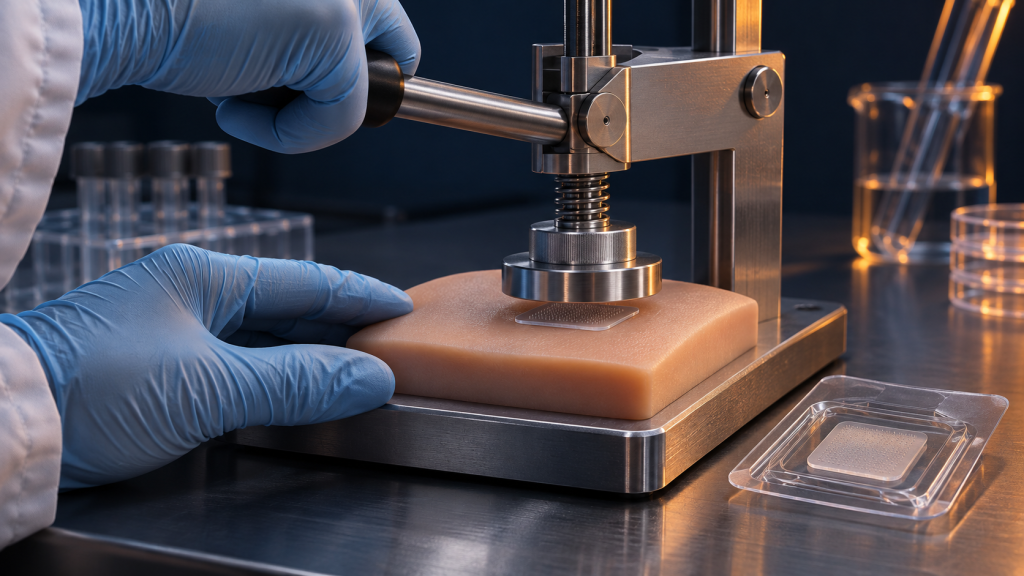
Specify the force-delivery method for bench testing and measure its variation. For a manual-use concept, observe how target users press without coaching and whether they keep full contact for the intended duration. Avoid importing a force value from a paper unless the array geometry, backing and test model match the proposed product. The 2018 digitally controlled applicator study compared six array designs under different pressing forces and impact velocities on ex vivo human skin. Its results depended on application mode and angle.
Angle, curvature and backing compliance
A flat coupon does not reproduce every face or body contour. Look for lifted corners, uneven contact and bending of the backing when the patch is placed on the intended cosmetic-use area or an appropriate model. Keep the test substrate and observation method in the record. A change from a stiff backing to a more flexible one may improve contact yet alter handling during liner removal.
Instructions and feedback
The instruction should identify the correct side, application site, placement action, pressure method, contact time and removal method. Test the wording and diagrams with people who have not seen the prototype before. If an applicator or tactile feedback is proposed, verify that the user can recognize the signal and that it does not damage the array. Do not use an invented sound, color change or press count in marketing copy before the feature exists in the finished design.
A practical formative study
- Use a representative packaged patch or safe surrogate with the proposed liner and backing.
- Give participants the draft instructions without a live demonstration. Record misunderstandings and help requests.
- Capture placement, orientation, pressure behavior, corner lift and removal using a method that respects privacy and consent.
- After use, inspect the array and test surface with the same predefined method used for bench comparisons.
- Revise the product or instructions, then repeat the most failure-prone tasks with fresh users.
A 2023 preliminary study compared trained and self-applied high-density microarray patches in 20 participants and used dermatoscopy and scanning electron microscopy to assess engagement. It demonstrates that application can be studied directly. Its vaccine-platform results do not establish safety, efficacy or instructions for a cosmetic dissolvable patch.
What belongs in the handoff package
Include the patch revision, target users, intended cosmetic-use site, draft instructions, test substrate, measured application conditions, observed error categories, array inspections and decisions taken after each study. If the geometry, backing, applicator or use area changes, review whether the previous application evidence still applies. Classification and allowed claims must be assessed separately for each destination market.
FAQ
Can a machine-controlled insertion result replace user testing?
No. It shows what the patch did under the machine’s specified conditions. User testing addresses handling, comprehension and variation during the intended use sequence.
Is an applicator required for every cosmetic microneedle patch?
No universal requirement follows from the cited studies. Compare manual and applicator-assisted concepts against the actual patch design and intended users.
Can the instructions specify a force copied from a published paper?
Only if that value is justified for the finished patch and users can apply it reliably. Published numbers from other array designs are research context, not ready-made use directions.
Related HYTANBIO resources
References
- Microneedle patches: usability and acceptability for self-vaccination, 2014.
- Universal applicator for controlled pressing force and impact velocity, 2018.
- Evaluation of self-administration of high-density microarray patches, 2023.
Scope: formative design and use research. The cited human and ex vivo studies involve medical or vaccine microneedle systems and cannot be used as cosmetic-product clinical evidence.